scene.py · 262 lines
"""Cafe table scene built only from Blender primitive meshes."""

import bpy
import bmesh
import math
from mathutils import Vector, Euler

# ---------------------------------------------------------------- clean scene
for obj in list(bpy.data.objects):
    bpy.data.objects.remove(obj, do_unlink=True)
for block in (bpy.data.meshes, bpy.data.materials, bpy.data.lights,
              bpy.data.cameras):
    for item in list(block):
        block.remove(item)


# ---------------------------------------------------------------- materials
def make_material(name, color, roughness=0.5, metallic=0.0, specular=0.5):
    mat = bpy.data.materials.new(name)
    mat.use_nodes = True
    bsdf = mat.node_tree.nodes.get("Principled BSDF")
    bsdf.inputs["Base Color"].default_value = (color[0], color[1], color[2], 1.0)
    bsdf.inputs["Roughness"].default_value = roughness
    bsdf.inputs["Metallic"].default_value = metallic
    if "Specular" in bsdf.inputs:
        bsdf.inputs["Specular"].default_value = specular
    # keep a recognisable viewport colour too
    mat.diffuse_color = (color[0], color[1], color[2], 1.0)
    return mat


MAT = {
    "porcelain": make_material("Porcelain", (0.88, 0.87, 0.82), 0.18, 0.0, 0.6),
    "table":     make_material("Table", (0.16, 0.075, 0.028), 0.55),
    "metal":     make_material("Metal", (0.72, 0.72, 0.74), 0.45, 1.0),
    "coffee":    make_material("Coffee", (0.23, 0.095, 0.025), 0.4),
    "crema":     make_material("Crema", (0.29, 0.140, 0.042), 0.5),
    "sugar":     make_material("Sugar", (0.88, 0.87, 0.83), 0.7),
    "croissant": make_material("Croissant", (0.24, 0.095, 0.016), 0.72),
    "floor":     make_material("Floor", (0.30, 0.28, 0.26), 0.75),
}


def add(obj, material, smooth=True, name=None):
    if name:
        obj.name = name
    obj.data.materials.append(material)
    if smooth:
        for poly in obj.data.polygons:
            poly.use_smooth = True
    return obj


# ---------------------------------------------------------------- table
bpy.ops.mesh.primitive_cylinder_add(radius=0.34, depth=0.028, location=(0, 0, -0.014))
add(bpy.context.active_object, MAT["table"], smooth=False, name="TableTop")

bpy.ops.mesh.primitive_cylinder_add(radius=0.030, depth=0.44, location=(0, 0, -0.248))
add(bpy.context.active_object, MAT["table"], name="TableColumn")

bpy.ops.mesh.primitive_cylinder_add(radius=0.135, depth=0.022, location=(0, 0, -0.468))
add(bpy.context.active_object, MAT["table"], smooth=False, name="TableBase")

# floor
bpy.ops.mesh.primitive_cube_add(size=2.0, location=(0, 0, -0.480))
floor = bpy.context.active_object
floor.scale = (1.0, 1.0, 0.01)
add(floor, MAT["floor"], smooth=False, name="Floor")

TOP = 0.0  # table surface height


# ---------------------------------------------------------------- saucer
SAUCER = Vector((-0.055, 0.005, 0.0))
bpy.ops.mesh.primitive_cylinder_add(radius=0.063, depth=0.006,
                                    location=SAUCER + Vector((0, 0, 0.003)))
add(bpy.context.active_object, MAT["porcelain"], smooth=False, name="SaucerBase")
bpy.ops.mesh.primitive_cone_add(radius1=0.055, radius2=0.064, depth=0.008,
                                location=SAUCER + Vector((0, 0, 0.009)))
add(bpy.context.active_object, MAT["porcelain"], name="SaucerLip")
bpy.ops.mesh.primitive_torus_add(major_radius=0.060, minor_radius=0.0035,
                                 major_segments=64, minor_segments=12,
                                 location=SAUCER + Vector((0, 0, 0.014)))
add(bpy.context.active_object, MAT["porcelain"], name="SaucerRim")

# ---------------------------------------------------------------- cup
CUP_R1 = 0.023   # bottom
CUP_R2 = 0.030   # top
CUP_H = 0.063
cup_base_z = 0.010
bpy.ops.mesh.primitive_cone_add(radius1=CUP_R1, radius2=CUP_R2, depth=CUP_H,
                                vertices=64, end_fill_type='NOTHING',
                                location=SAUCER + Vector((0, 0, cup_base_z + CUP_H / 2)))
add(bpy.context.active_object, MAT["porcelain"], name="CupBody")

# coffee fill
cup_top = cup_base_z + CUP_H
bpy.ops.mesh.primitive_cylinder_add(radius=CUP_R2 * 0.86, depth=0.006, vertices=64,
                                    location=SAUCER + Vector((0, 0, cup_top - 0.006)))
add(bpy.context.active_object, MAT["crema"], smooth=False, name="Coffee")

# rolled rim gives the ceramic rim some thickness
bpy.ops.mesh.primitive_torus_add(major_radius=CUP_R2 - 0.0015, minor_radius=0.0022,
                                 major_segments=64, minor_segments=12,
                                 location=SAUCER + Vector((0, 0, cup_top)))
add(bpy.context.active_object, MAT["porcelain"], name="CupRim")

# handle
HANDLE = Euler((math.radians(90), 0, math.radians(15)), 'XYZ')
bpy.ops.mesh.primitive_torus_add(major_radius=0.0105, minor_radius=0.0028,
                                 major_segments=48, minor_segments=12,
                                 location=SAUCER + Vector((0.0295, 0.0, 0.038)),
                                 rotation=HANDLE)
add(bpy.context.active_object, MAT["porcelain"], name="CupHandle")


# ---------------------------------------------------------------- spoon
def make_spoon(center, phi):
    rot = (0, 0, phi)
    d = Vector((math.cos(phi), math.sin(phi), 0))
    parts = []
    # bowl (shallow flattened ellipsoid)
    bowl_loc = Vector(center) + d * 0.036 + Vector((0, 0, 0.0050))
    bpy.ops.mesh.primitive_uv_sphere_add(segments=40, ring_count=20, radius=1.0,
                                         location=bowl_loc, rotation=rot)
    bowl = bpy.context.active_object
    bowl.scale = (0.0210, 0.0135, 0.0050)
    parts.append(add(bowl, MAT["metal"], name="SpoonBowl"))
    # neck joins bowl to handle
    neck_loc = Vector(center) + d * 0.008 + Vector((0, 0, 0.0042))
    bpy.ops.mesh.primitive_cube_add(size=1.0, location=neck_loc, rotation=rot)
    neck = bpy.context.active_object
    neck.scale = (0.0200, 0.0055, 0.0030)
    parts.append(add(neck, MAT["metal"], smooth=False, name="SpoonNeck"))
    # handle
    handle_loc = Vector(center) - d * 0.026 + Vector((0, 0, 0.0038))
    bpy.ops.mesh.primitive_cube_add(size=1.0, location=handle_loc, rotation=rot)
    handle = bpy.context.active_object
    handle.scale = (0.0480, 0.0048, 0.0030)
    parts.append(add(handle, MAT["metal"], smooth=False, name="SpoonHandle"))
    # unify into one object so it reads as a single utensil
    bpy.ops.object.select_all(action='DESELECT')
    for p in parts:
        p.select_set(True)
    bpy.context.view_layer.objects.active = parts[0]
    bpy.ops.object.join()


make_spoon(Vector((-0.010, -0.080, 0.0)), math.radians(207))


# ---------------------------------------------------------------- sugar cubes
def make_sugar_cube(loc, size=0.016, zrot=0.0):
    bpy.ops.mesh.primitive_cube_add(size=1.0, location=loc,
                                    rotation=(0, 0, zrot))
    cube = bpy.context.active_object
    cube.scale = (size, size, size)
    # bevel-ish: use a slightly smaller top? keep simple
    add(cube, MAT["sugar"], smooth=False, name="SugarCube")
    return cube


make_sugar_cube(Vector((-0.152, 0.090, 0.0080)), zrot=math.radians(5))
make_sugar_cube(Vector((-0.136, 0.090, 0.0080)), zrot=math.radians(-8))
make_sugar_cube(Vector((-0.144, 0.090, 0.0242)), zrot=math.radians(19))
make_sugar_cube(Vector((-0.168, 0.070, 0.0080)), zrot=math.radians(12))


# ---------------------------------------------------------------- croissant
def make_croissant(center, zrot=0.0, major=0.055, minor=0.021):
    bpy.ops.mesh.primitive_torus_add(major_radius=major, minor_radius=minor,
                                     major_segments=96, minor_segments=20,
                                     location=(0, 0, 0))
    obj = bpy.context.active_object
    me = obj.data
    bm = bmesh.new()
    bm.from_mesh(me)

    keep_limit = math.radians(148.0)

    # delete the "back" arc to open the crescent
    doomed = []
    for v in bm.verts:
        ang = math.atan2(v.co.y, v.co.x)
        if abs(ang) > keep_limit:
            doomed.append(v)
    bmesh.ops.delete(bm, geom=doomed, context='VERTS')

    # taper the arms, arch the body, add baked ridges
    for v in bm.verts:
        ang = math.atan2(v.co.y, v.co.x)
        t = max(-1.0, min(1.0, ang / keep_limit))
        taper = 0.13 + 0.87 * (math.cos(t * math.pi / 2) ** 0.95)
        phase = t * math.pi * 6.0
        ridge = 1.0 + 0.16 * math.cos(phase)
        ring = Vector((major * math.cos(ang), major * math.sin(ang), 0.0))
        arch = 0.018 * (1.0 - t * t)
        offset = v.co - ring
        v.co = ring + offset * (taper * ridge)
        v.co.z += arch

    # close the open ends
    bmesh.ops.holes_fill(bm, edges=bm.edges[:], sides=0)
    bm.to_mesh(me)
    bm.free()

    # sit on the table and place it
    min_z = min((obj.matrix_world @ v.co).z for v in me.vertices)
    obj.location = Vector(center) - Vector((0, 0, min_z))
    obj.rotation_euler = (0, 0, zrot)
    add(obj, MAT["croissant"], name="Croissant")


make_croissant(Vector((0.118, 0.050, 0.0)), zrot=math.radians(28),
               major=0.048, minor=0.019)


# ---------------------------------------------------------------- camera
cam_data = bpy.data.cameras.new("Camera")
cam_data.lens = 52
cam = bpy.data.objects.new("Camera", cam_data)
bpy.context.collection.objects.link(cam)
cam.location = Vector((0.045, -0.50, 0.245))
target = Vector((-0.02, 0.02, 0.03))
direction = target - cam.location
cam.rotation_euler = direction.to_track_quat('-Z', 'Y').to_euler()
bpy.context.scene.camera = cam


# ---------------------------------------------------------------- lights
def make_area(name, loc, energy, size, rot, color=(1.0, 1.0, 1.0)):
    data = bpy.data.lights.new(name, 'AREA')
    data.energy = energy
    data.size = size
    data.color = color
    obj = bpy.data.objects.new(name, data)
    obj.location = loc
    obj.rotation_euler = rot
    bpy.context.collection.objects.link(obj)
    return obj


make_area("KeyLight", (-0.42, -0.38, 0.52), 18.0, 0.35,
          (math.radians(52), 0, math.radians(-42)), (1.0, 0.90, 0.78))
make_area("FillLight", (0.48, -0.22, 0.34), 6.0, 0.45,
          (math.radians(62), 0, math.radians(58)), (0.92, 0.95, 1.0))
make_area("RimLight", (0.18, 0.50, 0.40), 7.0, 0.30,
          (math.radians(118), 0, math.radians(200)), (1.0, 0.85, 0.7))

world = bpy.data.worlds.new("World")
bpy.context.scene.world = world
world.use_nodes = True
bg = world.node_tree.nodes["Background"]
bg.inputs["Color"].default_value = (0.09, 0.075, 0.055, 1.0)
bg.inputs["Strength"].default_value = 0.4
bpy.context.scene.view_settings.exposure = -0.5

# nice filmic output if available
try:
    bpy.context.scene.view_settings.view_transform = 'Filmic'
except Exception:
    pass
round 1 of 12
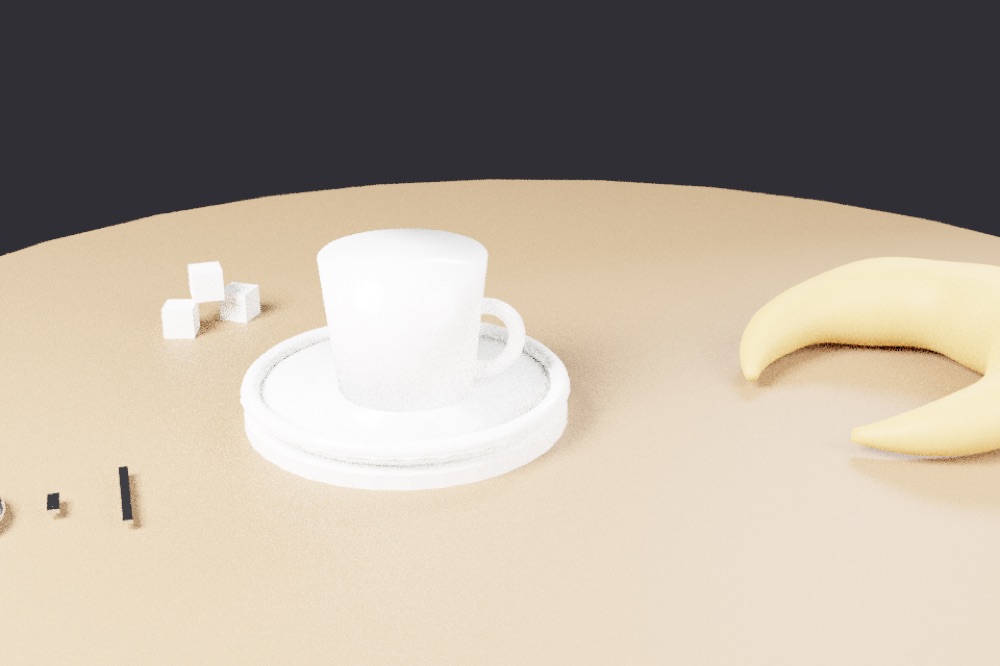
The spoon took six rounds. Twelve did not fix the croissant, and the clock stopped it rather than the model.
modeldeepseek/deepseek-v4.1-flashtaskblender-cafe-table@v1date2026-09-14rounds12 of 14 allowedcost$0.0774thinkingmediumtokens683,822 in, 32,809 out, of which 19,137 reasoningtime12 min 0 sfailurephysical-plausibility
What the harness did to this run. The 12-minute clock ended it before the model finished, so this is where it had got to when time ran out. It was allowed 14 rounds instead of the usual 8, and used 12 of them.
All five objectsdecided by looking · Pass if all five can be pointed at in the render as separate objects. One missing, or hidden behind another, fails it.pass
Primitives onlydecided by a number, from the filepass
Spoon reads as a spoondecided by looking · Pass if the spoon is one connected piece with a bowl at one end, wider than the handle, and the handle running from it in a line. Loose parts, or no handle, fail it.pass
Croissant reads as a croissantdecided by looking · Pass if it is a crescent that is thickest in the middle and tapers to both tips, with segments or scoring across it. A smooth curved tube fails it, and so does a segmented one with no taper.fail
Consistent scaledecided by a number, from the filepass
same prompt, other modelsall 2 runs on Café table from primitives →
Write a Blender Python script that builds a café table scene — an espresso cup on a saucer, a spoon, sugar cubes and a croissant — using only primitive meshes (cube, cylinder, cone, sphere, torus).Frozen at v1. This model got this and nothing else. The prompt has since moved to v2, on 2026-09-20, so this run is not directly comparable with one made after that date. Both wordings are on the task page.
The render, and the script that made it: the objects a person would name unprompted, at sizes a person would accept. A 5 cm spoon and an 11 cm croissant are checkable in the source. How it is scored, and this run's files on GitHub.