scene.py · 382 lines
# -*- coding: utf-8 -*-
"""
Cafe table scene, built ONLY from primitive meshes
(cube, cylinder, cone, sphere, torus) placed with transforms.

Contents: round bistro table, espresso cup on a saucer, a spoon,
three sugar cubes, a croissant (plus a few crumbs).
"""

import bpy
import math
from mathutils import Vector

# --------------------------------------------------------------------------
# helpers
# --------------------------------------------------------------------------


def _clear():
    """Start from an empty scene (factory startup gives objects we don't want)."""
    bpy.ops.object.select_all(action='SELECT')
    if bpy.context.selected_objects:
        bpy.ops.object.delete()
    for block in (bpy.data.meshes, bpy.data.materials, bpy.data.lights,
                  bpy.data.cameras):
        for d in list(block):
            if d.users == 0:
                block.remove(d)


_clear()

COLLECTION = bpy.context.scene.collection


def _finish(obj, name, loc, rot, scale, mat):
    """The primitive ops bake the size into the mesh, so the object scale here
    is taken verbatim as the world scale."""
    obj.name = name
    obj.location = Vector(loc)
    obj.rotation_euler = rot
    obj.scale = Vector((obj.scale.x * scale[0],
                        obj.scale.y * scale[1],
                        obj.scale.z * scale[2]))
    if mat is not None:
        obj.data.materials.append(mat)
    for p in obj.data.polygons:
        p.use_smooth = False
    return obj


def box(name="Cube", size=1.0, loc=(0, 0, 0), rot=(0, 0, 0), scale=(1, 1, 1),
        mat=None):
    """scale = the three full edge lengths of the box."""
    bpy.ops.mesh.primitive_cube_add(size=size, location=(0, 0, 0))
    return _finish(bpy.context.active_object, name, loc, rot, scale, mat)


def cyl(name="Cylinder", r=1.0, depth=1.0, loc=(0, 0, 0), rot=(0, 0, 0),
        scale=(1, 1, 1), mat=None, verts=64, cap='NGON', smooth=False):
    bpy.ops.mesh.primitive_cylinder_add(vertices=verts, radius=r, depth=depth,
                                        location=(0, 0, 0), end_fill_type=cap)
    return _smooth(_finish(bpy.context.active_object, name, loc, rot, scale,
                           mat), smooth)


def cone(name="Cone", r1=1.0, r2=0.0, depth=1.0, loc=(0, 0, 0), rot=(0, 0, 0),
         scale=(1, 1, 1), mat=None, verts=64, cap='NGON', smooth=False,
         direction=None):
    if direction is not None:
        rot = Vector(direction).normalized().to_track_quat('Z', 'Y').to_euler()
    bpy.ops.mesh.primitive_cone_add(vertices=verts, radius1=r1, radius2=r2,
                                    depth=depth, location=(0, 0, 0),
                                    end_fill_type=cap)
    return _smooth(_finish(bpy.context.active_object, name, loc, rot, scale,
                           mat), smooth)


def sph(name="Sphere", r=1.0, loc=(0, 0, 0), rot=(0, 0, 0), scale=(1, 1, 1),
        mat=None, segs=32, rings=16, smooth=True):
    bpy.ops.mesh.primitive_uv_sphere_add(segments=segs, ring_count=rings,
                                         radius=r, location=(0, 0, 0))
    return _smooth(_finish(bpy.context.active_object, name, loc, rot, scale,
                           mat), smooth)


def tor(name="Torus", R=1.0, r=0.1, loc=(0, 0, 0), rot=(0, 0, 0),
        scale=(1, 1, 1), mat=None, smooth=True, major_seg=48, minor_seg=16):
    bpy.ops.mesh.primitive_torus_add(major_radius=R, minor_radius=r,
                                     major_segments=major_seg,
                                     minor_segments=minor_seg,
                                     location=(0, 0, 0))
    return _smooth(_finish(bpy.context.active_object, name, loc, rot, scale,
                           mat), smooth)


def _smooth(o, on):
    if on:
        for p in o.data.polygons:
            p.use_smooth = True
        if hasattr(o.data, "use_auto_smooth"):
            o.data.use_auto_smooth = True
            o.data.auto_smooth_angle = math.radians(60)
    return o


def setin(node, names, value):
    """Set the first input that exists (Blender version proofing)."""
    for n in names:
        if n in node.inputs:
            node.inputs[n].default_value = value
            return True
    return False


def material(name, color, rough=0.5, metal=0.0, spec=0.5, sss=0.0,
             sss_radius=None, ior=1.45):
    m = bpy.data.materials.new(name)
    m.use_nodes = True
    b = m.node_tree.nodes.get("Principled BSDF")
    setin(b, ["Base Color"], (*color, 1.0))
    setin(b, ["Roughness"], rough)
    setin(b, ["Metallic"], metal)
    setin(b, ["Specular IOR Level", "Specular"], spec)
    if sss:
        setin(b, ["Subsurface Weight", "Subsurface"], sss)
        if sss_radius:
            setin(b, ["Subsurface Radius"], sss_radius)
    setin(b, ["IOR", "Index of Refraction"], ior)
    return m


def aim(obj, target):
    """Point an object's -Z axis at a world position."""
    d = Vector(target) - Vector(obj.location)
    obj.rotation_euler = d.to_track_quat('-Z', 'Y').to_euler()


def link_light(name, kind, loc, energy, color=(1, 1, 1), target=(0, 0, 0),
               **kw):
    ld = bpy.data.lights.new(name, kind)
    for k, v in kw.items():
        if hasattr(ld, k):
            setattr(ld, k, v)
    ld.energy = energy
    ld.color = color
    o = bpy.data.objects.new(name, ld)
    o.location = loc
    COLLECTION.objects.link(o)
    aim(o, target)
    return o


def place_group(objs, offset, angle_z=0.0):
    """Rotate a locally-built group about Z, then move it into place."""
    c, s = math.cos(angle_z), math.sin(angle_z)
    for o in objs:
        p = Vector(o.location)
        p = Vector((p.x * c - p.y * s, p.x * s + p.y * c, p.z)) + Vector(offset)
        o.location = p
        o.rotation_euler = (o.rotation_euler[0], o.rotation_euler[1],
                            o.rotation_euler[2] + angle_z)


# --------------------------------------------------------------------------
# materials
# --------------------------------------------------------------------------
porcelain = material("Porcelain", (0.80, 0.795, 0.78), rough=0.15, spec=0.4)
porcelain_deep = material("PorcelainDeep", (0.62, 0.615, 0.605), rough=0.12)
coffee = material("Coffee", (0.085, 0.032, 0.013), rough=0.32, spec=0.35)
coffee_dark = material("CoffeeDark", (0.028, 0.010, 0.004), rough=0.26, spec=0.3)
crema = material("Crema", (0.42, 0.215, 0.09), rough=0.5, spec=0.25)
steel = material("Steel", (0.62, 0.63, 0.65), rough=0.18, metal=1.0, spec=0.9)
sugar = material("Sugar", (0.86, 0.855, 0.83), rough=0.40, sss=0.08,
                 sss_radius=(0.008, 0.006, 0.004))
crust_a = material("CrustA", (0.315, 0.125, 0.038), rough=0.45, spec=0.28)
crust_b = material("CrustB", (0.455, 0.205, 0.065), rough=0.40, spec=0.28)
crust_c = material("CrustC", (0.22, 0.082, 0.024), rough=0.50, spec=0.25)
floor_mat = material("Floor", (0.045, 0.040, 0.038), rough=0.9)

# wood with a soft procedural grain (material nodes only - geometry stays primitive)
wood = material("Wood", (0.20, 0.093, 0.042), rough=0.42, spec=0.30)
nt = wood.node_tree
bsdf = nt.nodes["Principled BSDF"]
tc = nt.nodes.new("ShaderNodeTexCoord")
mp = nt.nodes.new("ShaderNodeMapping")
mp.inputs["Scale"].default_value = (1.0, 16.0, 1.0)
wave = nt.nodes.new("ShaderNodeTexNoise")
wave.inputs["Scale"].default_value = 7.0
wave.inputs["Detail"].default_value = 6.0
wave.inputs["Roughness"].default_value = 0.55
ramp = nt.nodes.new("ShaderNodeValToRGB")
ramp.color_ramp.elements[0].position = 0.34
ramp.color_ramp.elements[0].color = (0.088, 0.034, 0.013, 1)
ramp.color_ramp.elements[1].position = 0.72
ramp.color_ramp.elements[1].color = (0.215, 0.098, 0.042, 1)
nt.links.new(tc.outputs["Object"], mp.inputs["Vector"])
nt.links.new(mp.outputs["Vector"], wave.inputs["Vector"])
nt.links.new(wave.outputs["Color"], ramp.inputs["Fac"])
nt.links.new(ramp.outputs["Color"], bsdf.inputs["Base Color"])

# --------------------------------------------------------------------------
# table (round bistro top, pedestal, base, floor)
# --------------------------------------------------------------------------
cyl("TableTop", r=0.36, depth=0.026, loc=(0, 0, -0.013), mat=wood, verts=128)
tor("TableEdge", R=0.355, r=0.0125, loc=(0, 0, -0.024), mat=wood)
cyl("Pedestal", r=0.026, depth=0.66, loc=(0, 0, -0.356), mat=porcelain_deep,
    verts=48)
cone("PedestalCollar", r1=0.058, r2=0.027, depth=0.055, loc=(0, 0, -0.064),
     mat=porcelain_deep, verts=48)
cone("TableFoot", r1=0.175, r2=0.055, depth=0.038, loc=(0, 0, -0.700),
     mat=porcelain_deep, verts=64)
box("Floor", loc=(0, 0, -0.7525), scale=(6, 6, 0.05), mat=floor_mat)

# --------------------------------------------------------------------------
# saucer + espresso cup  (built around the origin, then shifted as a unit)
# --------------------------------------------------------------------------
cup = []
# --- saucer: foot ring + flaring skirt + top + rolled rim
cup.append(cyl("SaucerFoot", r=0.0305, depth=0.0068, loc=(0, 0, 0.0034),
               mat=porcelain, verts=96))
cup.append(cone("SaucerSkirt", r1=0.0305, r2=0.0580, depth=0.0088,
                loc=(0, 0, 0.0096), mat=porcelain, verts=96, cap='NOTHING'))
cup.append(cyl("SaucerTop", r=0.0580, depth=0.0016, loc=(0, 0, 0.0130),
               mat=porcelain, verts=96))
cup.append(tor("SaucerRim", R=0.0580, r=0.0030, loc=(0, 0, 0.0138),
               mat=porcelain))
cup.append(tor("SaucerGroove", R=0.0400, r=0.0022, loc=(0, 0, 0.0140),
               mat=porcelain_deep))
# --- cup: one watertight truncated cone, so the handle can be buried in it
CZ0 = 0.0144                     # cup bottom, resting inside the saucer well
CH = 0.055
RIM = CZ0 + CH
cup.append(cone("CupBody", r1=0.0240, r2=0.0295, depth=CH,
                loc=(0, 0, CZ0 + CH / 2), mat=porcelain, verts=96))
cup.append(tor("CupRim", R=0.0276, r=0.0030, loc=(0, 0, RIM), mat=porcelain))
# --- espresso: a thin disc whose top face sits just under the rim crest
TOP = RIM + 0.0018
cup.append(cyl("Coffee", r=0.0270, depth=0.010, loc=(0, 0, TOP - 0.005),
               mat=coffee, verts=96))
cup.append(cyl("CoffeeHeart", r=0.0165, depth=0.0104,
               loc=(0, 0, TOP + 0.0002 - 0.0052), mat=coffee_dark, verts=64))
cup.append(tor("CoffeeEdge", R=0.0242, r=0.0014, loc=(0, 0, TOP - 0.0012),
               mat=crema))
# --- handle: a torus standing in a vertical plane that contains the cup axis.
#     Its inner half is buried in the convex (watertight) cup body, so it reads
#     as a handle joined to the wall at two points.
A = 34.0                         # azimuth the handle points at (in profile)
HA = math.radians(A)
HD, HR, HT = 0.0215, 0.0180, 0.0036
# after rot=(0, 90deg, ez) the ring's in-plane horizontal axis is
# (-sin ez, cos ez, 0); we want that to be the radial direction (cos HA, sin HA)
cup.append(tor("CupHandle", R=HR, r=HT,
               loc=(HD * math.cos(HA), HD * math.sin(HA), CZ0 + 0.56 * CH),
               rot=(0, math.radians(90), HA - math.radians(90)),
               mat=porcelain))

place_group(cup, (-0.030, 0.050, 0.0))

# --------------------------------------------------------------------------
# spoon, lying on the table at the front right
# --------------------------------------------------------------------------
spoon = []
spoon.append(sph("SpoonBowl", r=1.0, loc=(0, 0.0480, 0.0014),
                 scale=(0.0075, 0.0130, 0.0014), mat=steel))
spoon.append(box("SpoonNeck", loc=(0, 0.0255, 0.0012),
                 scale=(0.0055, 0.0260, 0.0012), mat=steel))
spoon.append(box("SpoonHandle", loc=(0, -0.0140, 0.0011),
                 scale=(0.0085, 0.0500, 0.0011), mat=steel))
spoon.append(sph("SpoonTip", r=1.0, loc=(0, -0.0430, 0.0010),
                 scale=(0.0058, 0.0085, 0.0010), mat=steel))
place_group(spoon, (0.108, -0.048, 0.0), math.radians(28))

# --------------------------------------------------------------------------
# sugar cubes: a stack of two plus one lying beside it (back right)
# --------------------------------------------------------------------------
SC = 0.0185
box("Sugar1", size=SC, loc=(0.086, 0.126, SC / 2),
    rot=(0, 0, math.radians(14)), mat=sugar)
box("Sugar2", size=SC, loc=(0.088, 0.128, SC * 1.5 - 0.0006),
    rot=(0, 0, math.radians(33)), mat=sugar)
box("Sugar3", size=SC, loc=(0.136, 0.101, SC / 2),
    rot=(0, 0, math.radians(-22)), mat=sugar)

# --------------------------------------------------------------------------
# croissant: spheres along an arc + two tapered horn tips (front left)
# --------------------------------------------------------------------------
cro = []
ARC_R = 0.047
SPAN = math.radians(150)
PROF = [0.0165, 0.0210, 0.0235, 0.0210, 0.0165]
MATS = [crust_a, crust_b, crust_b, crust_b, crust_a]
N = len(PROF)
for i in range(N):
    t = math.radians(90) - SPAN / 2 + SPAN * i / (N - 1)
    rr = PROF[i]
    x = ARC_R * math.cos(t)
    y = ARC_R * math.sin(t) - ARC_R          # centre the crescent on the origin
    cro.append(sph("Croissant%d" % i, r=rr, loc=(x, y, rr * 0.76),
                   rot=(0, 0, t), scale=(0.86, 0.98, 0.78), mat=MATS[i]))


def horn(idx, sign):
    t = math.radians(90) + sign * SPAN / 2
    dirv = Vector((-math.sin(t) * sign, math.cos(t) * sign, -0.34)).normalized()
    j = 0 if sign < 0 else N - 1
    base = Vector((ARC_R * math.cos(t), ARC_R * math.sin(t) - ARC_R,
                   PROF[j] * 0.72))
    length = 0.030
    c = cone("CroissantTip%d" % idx, r1=PROF[j] * 0.72, r2=0.0012, depth=length,
             loc=(base + dirv * (length / 2)), mat=crust_a, verts=32,
             direction=dirv)
    return c


cro.append(horn(0, -1))
cro.append(horn(1, 1))
place_group(cro, (-0.100, -0.052, 0.0), math.radians(-30))

# crumbs
for i, (cx, cy, cr) in enumerate([(0.010, -0.115, 0.0018), (-0.028, -0.140, 0.0014),
                                  (0.040, -0.020, 0.0015), (-0.005, -0.020, 0.0012),
                                  (0.052, -0.098, 0.0011)]):
    sph("Crumb%d" % i, r=cr, loc=(cx, cy, cr * 0.45), scale=(1, 1.4, 0.55),
        mat=crust_a, segs=12, rings=6)

# --------------------------------------------------------------------------
# camera + lights
# --------------------------------------------------------------------------
TARGET = (-0.004, 0.020, 0.026)
cam_data = bpy.data.cameras.new("Camera")
cam_data.lens = 50
cam_data.sensor_width = 36
cam_data.clip_start = 0.008
cam = bpy.data.objects.new("Camera", cam_data)
cam.location = (0.40, -0.55, 0.42)
COLLECTION.objects.link(cam)
aim(cam, TARGET)
bpy.context.scene.camera = cam

link_light("Key", 'AREA', (0.50, -0.40, 0.62), 14.0,
           color=(1.0, 0.94, 0.85), size=0.24, target=TARGET)
link_light("Fill", 'AREA', (-0.60, -0.40, 0.35), 4.0,
           color=(0.85, 0.90, 1.0), size=1.2, target=TARGET)
link_light("Rim", 'SPOT', (-0.35, 0.62, 0.42), 10.0,
           color=(1.0, 0.90, 0.76), spot_size=math.radians(60), blend=0.5,
           target=(0.0, 0.03, 0.05))

world = bpy.data.worlds.get("World") or bpy.data.worlds.new("World")
bpy.context.scene.world = world
world.use_nodes = True
bg = world.node_tree.nodes.get("Background")
bg.inputs[0].default_value = (0.055, 0.05, 0.048, 1.0)
bg.inputs[1].default_value = 1.0

# --------------------------------------------------------------------------
# render settings (the harness overrides engine/samples/resolution)
# --------------------------------------------------------------------------
sc = bpy.context.scene
sc.render.engine = 'CYCLES'
sc.cycles.device = 'CPU'
sc.cycles.samples = 96
sc.cycles.use_denoising = False
for prop, val in (("sample_clamp_indirect", 6.0), ("max_bounces", 6),
                  ("diffuse_bounces", 2), ("glossy_bounces", 3),
                  ("transmission_bounces", 0), ("volume_bounces", 0),
                  ("caustics_reflective", False), ("caustics_refractive", False)):
    if hasattr(sc.cycles, prop):
        setattr(sc.cycles, prop, val)
if hasattr(sc.cycles, "pixel_filter_type"):
    sc.cycles.pixel_filter_type = 'GAUSSIAN'
if hasattr(sc.cycles, "pixel_filter_width"):
    sc.cycles.pixel_filter_width = 1.6
sc.view_settings.view_transform = 'Filmic'
try:
    sc.view_settings.look = 'Medium High Contrast'
except Exception:
    pass
sc.render.resolution_x = 960
sc.render.resolution_y = 640
sc.render.image_settings.file_format = 'PNG'
round 1 of 4
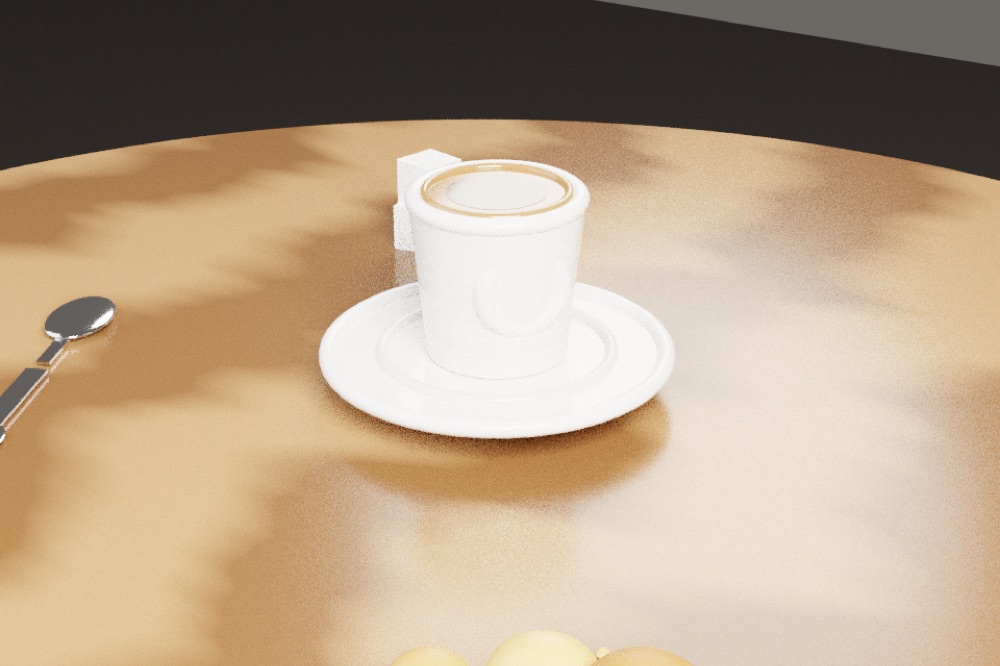
A crude spoon that passes, and a croissant of five balls with a cone at each end.
modelqwen/qwen3.8-flashtaskblender-cafe-table@v1date2026-09-20rounds4 of 8 allowedcost$0.0673thinkingmediumtokens1,066,990 in, 74,682 out, of which 46,837 reasoningtime28 min 0 sfailurephysical-plausibility
What the harness did to this run. The 28-minute clock ended it before the model finished, so this is where it had got to when time ran out.
All five objectsdecided by looking · Pass if all five can be pointed at in the render as separate objects. One missing, or hidden behind another, fails it.pass
Primitives onlydecided by a number, from the filepass
Spoon reads as a spoondecided by looking · Pass if the spoon is one connected piece with a bowl at one end, wider than the handle, and the handle running from it in a line. Loose parts, or no handle, fail it.pass
Croissant reads as a croissantdecided by looking · Pass if it is a crescent that is thickest in the middle and tapers to both tips, with segments or scoring across it. A smooth curved tube fails it, and so does a segmented one with no taper.fail
Consistent scaledecided by a number, from the filepass
There is no post about this one, since only some results need one, so the picture, the source and the scoring are here instead.
same prompt, other modelsall 2 runs on Café table from primitives →
Write a Blender Python script that builds a café table scene — an espresso cup on a saucer, a spoon, sugar cubes and a croissant — using only primitive meshes (cube, cylinder, cone, sphere, torus).Frozen at v1. This model got this and nothing else. The prompt has since moved to v2, on 2026-09-20, so this run is not directly comparable with one made after that date. Both wordings are on the task page.
The render, and the script that made it: the objects a person would name unprompted, at sizes a person would accept. A 5 cm spoon and an 11 cm croissant are checkable in the source. How it is scored, and this run's files on GitHub.