hopper.py · 320 lines
"""Grinder hopper releasing 50 roasted coffee beans through an 18 mm throat.

Units: metres, kilograms, seconds.  z = 0 is the throat plane, +z up.
  * Hopper: 24-facet cone, inner radius 50 mm at z=140 mm narrowing to the
    9 mm throat radius at z=20 mm, then an 18 mm throat tube down to z=0.
  * Gate: kinematic (mocap) plate under the throat; closed until 1 s, then
    slides sideways out of the throat footprint over 0.3 s.
  * Tray: flat plate at z=-100 mm.
  * Bean: one free body = two overlapping ellipsoids. The upper one is the
    domed face; the lower one is offset down and flattened so the bottom is
    a broad, nearly flat face.
"""
import os
import numpy as np
import mujoco
import matplotlib
matplotlib.use("Agg")
import matplotlib.pyplot as plt

HERE = os.path.dirname(os.path.abspath(__file__))
OUT = os.environ.get("OUT", os.path.join(HERE, "figure.png"))

# ---------------- parameters ----------------
N_BEANS = 50
THROAT_R = 0.009                     # 18 mm throat
TOP_Z, TOP_R = 0.140, 0.050
CONE_BOT_Z = 0.020
N_FACETS = 24
WALL_T = 0.002
GATE_T0, GATE_T1, GATE_X_OPEN = 1.0, 1.3, 0.06
GATE_Z = -0.003                      # gate centre height (plate spans z -0.006..0)
TRAY_Z = -0.100
SIM_T = 5.0
DT = 1.0e-4                          # solver / integration timestep
REC_DT = 0.01
BEAN_MASS = 1.3e-4                   # 0.13 g roasted bean
A_DOME = (0.0055, 0.0035, 0.0030)   # semi-axes of domed ellipsoid (m)
A_FLAT = (0.0055, 0.0035, 0.0016)   # semi-axes of flattened ellipsoid (m)
FLAT_OFFSET = -0.0016                # z-centre of flat ellipsoid in bean frame
FRIC_BEAN = "0.4 0.005 0.0001"       # sliding, torsional, rolling
FRIC_WALL = "0.3 0.005 0.0001"
SOLREF = "0.002 1"
SOLIMP = "0.9 0.95 0.001"
SEED = 7
SNAP_TIMES = [0.0, 1.0, 2.0, 5.0]
DIAG_TIME = 2.0


def radius_at(z):
    """Nominal inner hopper radius at height z."""
    if z >= CONE_BOT_Z:
        f = (z - CONE_BOT_Z) / (TOP_Z - CONE_BOT_Z)
        return THROAT_R + f * (TOP_R - THROAT_R)
    return THROAT_R


def quat_from_cols(X, Y, Z):
    q = np.zeros(4)
    mujoco.mju_mat2Quat(q, np.column_stack([X, Y, Z]).reshape(-1))
    return q


def frustum_facets(z0, R0, z1, R1, prefix):
    """Flat facet boxes approximating a frustum; inner faces at the nominal radius."""
    out = []
    dr, dz = R1 - R0, z1 - z0
    L = np.hypot(dr, dz)
    d = np.array([dr, dz]) / L                  # generatrix direction (r, z)
    n = np.array([-d[1], d[0]])                 # outward normal (r, z)
    rm = 0.5 * (R0 + R1) / np.cos(np.pi / N_FACETS)   # facet mid-plane distance
    zm = 0.5 * (z0 + z1)
    half_w = rm * np.sin(np.pi / N_FACETS) * 1.2
    for i in range(N_FACETS):
        th = 2 * np.pi * i / N_FACETS
        ct, st = np.cos(th), np.sin(th)
        X = np.array([d[0] * ct, d[0] * st, d[1]])
        Y = np.array([-st, ct, 0.0])
        Z = np.array([n[0] * ct, n[0] * st, n[1]])
        # facet inner face lies on the mid-plane at distance rm*cos? -> we place the
        # box so that its inner surface is at the nominal apothem radius.
        apo = 0.5 * (R0 + R1)
        centre = np.array([apo * ct, apo * st, zm]) + Z * (WALL_T / 2)
        q = quat_from_cols(X, Y, Z)
        out.append(
            f'<geom name="{prefix}{i}" type="box" size="{L/2+0.0005:.6f} {half_w:.6f} {WALL_T/2:.6f}" '
            f'pos="{centre[0]:.6f} {centre[1]:.6f} {centre[2]:.6f}" '
            f'quat="{q[0]:.6f} {q[1]:.6f} {q[2]:.6f} {q[3]:.6f}" '
            f'friction="{FRIC_WALL}" solref="{SOLREF}" solimp="{SOLIMP}" rgba="0.55 0.6 0.7 1"/>')
    return out


def bean_inertia():
    a, b, c = A_DOME
    return BEAN_MASS * np.array([b * b + c * c, a * a + c * c, a * a + b * b]) / 5.0


def build_xml(pos0, quat0):
    walls = frustum_facets(TOP_Z, TOP_R, CONE_BOT_Z, THROAT_R, "wall_cone")
    walls += frustum_facets(CONE_BOT_Z, THROAT_R, 0.0, THROAT_R, "wall_throat")
    I = bean_inertia()
    beans = []
    for i in range(N_BEANS):
        p, q = pos0[i], quat0[i]
        beans.append(f'''
    <body name="bean{i}" pos="{p[0]:.6f} {p[1]:.6f} {p[2]:.6f}" quat="{q[0]:.6f} {q[1]:.6f} {q[2]:.6f} {q[3]:.6f}">
      <freejoint name="bean{i}_free"/>
      <inertial pos="0 0 0" mass="{BEAN_MASS}" diaginertia="{I[0]:.4e} {I[1]:.4e} {I[2]:.4e}"/>
      <geom name="bean{i}_dome" type="ellipsoid" size="{A_DOME[0]} {A_DOME[1]} {A_DOME[2]}"
            friction="{FRIC_BEAN}" solref="{SOLREF}" solimp="{SOLIMP}" rgba="0.45 0.27 0.15 1"/>
      <geom name="bean{i}_flat" type="ellipsoid" size="{A_FLAT[0]} {A_FLAT[1]} {A_FLAT[2]}"
            pos="0 0 {FLAT_OFFSET}" friction="{FRIC_BEAN}" solref="{SOLREF}" solimp="{SOLIMP}"
            rgba="0.45 0.27 0.15 1"/>
    </body>''')
    return f'''<mujoco model="grinder_hopper">
  <compiler angle="radian"/>
  <option timestep="{DT}" gravity="0 0 -9.81" integrator="Euler" solver="Newton"
          iterations="100" tolerance="1e-8" cone="elliptic" impratio="10"/>
  <default><geom condim="3" margin="0.0"/></default>
  <worldbody>
    <light pos="0 0 0.5" dir="0 0 -1"/>
    <geom name="tray" type="box" size="0.15 0.15 0.004" pos="0 0 {TRAY_Z-0.004:.4f}"
          friction="{FRIC_WALL}" solref="{SOLREF}" solimp="{SOLIMP}" rgba="0.8 0.8 0.8 1"/>
    {''.join(walls)}
    <body name="gate" mocap="true" pos="0 0 {GATE_Z}">
      <geom name="gate_plate" type="box" size="0.014 0.02 0.003" friction="{FRIC_WALL}"
            solref="{SOLREF}" solimp="{SOLIMP}" rgba="0.9 0.3 0.2 1"/>
    </body>
    {''.join(beans)}
  </worldbody>
</mujoco>
'''


def sample_initial(rng):
    """Random non-overlapping bean poses filling the cone above the gate."""
    pos, quat = [], []
    tries = 0
    while len(pos) < N_BEANS:
        tries += 1
        if tries > 500000:
            raise RuntimeError("could not place beans")
        z = rng.uniform(0.025, 0.11)
        R = radius_at(z) - 0.007
        r = R * np.sqrt(rng.uniform())
        th = rng.uniform(0, 2 * np.pi)
        p = np.array([r * np.cos(th), r * np.sin(th), z])
        if all(np.linalg.norm(p - q) > 0.0130 for q in pos):
            pos.append(p)
            qq = rng.normal(size=4)
            quat.append(qq / np.linalg.norm(qq))
    return np.array(pos), np.array(quat)


def gate_x(t):
    if t <= GATE_T0:
        return 0.0
    if t >= GATE_T1:
        return GATE_X_OPEN
    return GATE_X_OPEN * (t - GATE_T0) / (GATE_T1 - GATE_T0)


def surface_points(p, q, n_u=28, n_v=14):
    """World-frame surface samples of both ellipsoids of one bean (pos p, quat q)."""
    R = np.zeros(9)
    mujoco.mju_quat2Mat(R, q)
    R = R.reshape(3, 3)
    u, v = np.meshgrid(np.linspace(0, 2 * np.pi, n_u), np.linspace(0, np.pi, n_v))
    unit = np.stack([np.cos(u) * np.sin(v), np.sin(u) * np.sin(v), np.cos(v)], -1).reshape(-1, 3)
    pts = []
    for a, off in ((A_DOME, np.zeros(3)), (A_FLAT, np.array([0, 0, FLAT_OFFSET]))):
        pts.append((unit * np.array(a) + off) @ R.T + p)
    return np.vstack(pts)


def draw_hopper(ax, gx):
    zz = np.linspace(CONE_BOT_Z, TOP_Z, 50)
    Rz = np.array([radius_at(z) for z in zz])
    ax.plot(Rz, zz, "k-", lw=1.5); ax.plot(-Rz, zz, "k-", lw=1.5)
    ax.plot([-THROAT_R, -THROAT_R], [0, CONE_BOT_Z], "k-", lw=1.5)
    ax.plot([THROAT_R, THROAT_R], [0, CONE_BOT_Z], "k-", lw=1.5)
    ax.plot([-0.15, 0.15], [TRAY_Z, TRAY_Z], color="0.5", lw=3)
    ax.add_patch(plt.Rectangle((gx - 0.014, GATE_Z - 0.003), 0.028, 0.006, color="tab:red", alpha=0.8))
    ax.set_xlim(-0.07, 0.09); ax.set_ylim(TRAY_Z - 0.01, TOP_Z + 0.01)
    ax.set_aspect("equal"); ax.set_xlabel("x [m]"); ax.set_ylabel("z [m]")


def main():
    rng = np.random.default_rng(SEED)
    pos0, quat0 = sample_initial(rng)
    xml = build_xml(pos0, quat0)
    xml_path = os.path.join(HERE, "model.xml")
    with open(xml_path, "w") as f:
        f.write(xml)

    m = mujoco.MjModel.from_xml_string(xml)
    d = mujoco.MjData(m)
    mid = m.body("gate").mocapid[0]
    bodies = [m.body(f"bean{i}").id for i in range(N_BEANS)]
    wall_geom = np.array([(mujoco.mj_id2name(m, mujoco.mjtObj.mjOBJ_GEOM, g) or "").startswith("wall")
                          for g in range(m.ngeom)])
    bean_of_geom = np.array([b - bodies[0] if b in bodies else -1 for b in m.geom_bodyid])

    n_steps = int(round(SIM_T / DT))
    rec_every = int(round(REC_DT / DT))
    snap_steps = {int(round(t / DT)): t for t in SNAP_TIMES}
    diag_step = int(round(DIAG_TIME / DT))

    passed = np.zeros(N_BEANS, bool)
    left = set()
    max_pen, max_pen_bean = 0.0, -1
    count_t, count_n, rec_xyz = [], [], []
    snaps, diag = {}, None

    for step in range(n_steps + 1):
        t = step * DT
        d.mocap_pos[mid] = [gate_x(t), 0.0, GATE_Z]
        if step % 10 == 0 or step in snap_steps or step == diag_step:
            mujoco.mj_forward(m, d)
        # penetration into hopper walls (negative dist = overlap)
        for k in range(d.ncon):
            c = d.contact[k]
            if wall_geom[c.geom1] or wall_geom[c.geom2]:
                other = c.geom2 if wall_geom[c.geom1] else c.geom1
                if -c.dist > max_pen:
                    max_pen, max_pen_bean = -c.dist, bean_of_geom[other]
        if step % rec_every == 0:
            bp = d.xpos[bodies].copy()
            bq = d.xquat[bodies].copy()
            newly = (~passed) & (bp[:, 2] < GATE_Z)
            passed |= newly
            count_t.append(t); count_n.append(int(passed.sum()))
            rec_xyz.append(bp)
            for i in range(N_BEANS):
                if np.hypot(*bp[i, :2]) > 0.2 or bp[i, 2] < TRAY_Z - 0.1:
                    left.add(i)
        if step in snap_steps:
            snaps[snap_steps[step]] = (d.xpos[bodies].copy(), d.xquat[bodies].copy(), passed.copy())
        if step == diag_step:
            cons = []
            for k in range(d.ncon):
                c = d.contact[k]
                f6 = np.zeros(6)
                mujoco.mj_contactForce(m, d, k, f6)
                cons.append((c.pos.copy(), c.frame[:3].copy(), f6[0], c.dist))
            diag = (t, cons)
        if step == n_steps:
            break
        mujoco.mj_step(m, d)

    # ---------- report ----------
    print(f"model written: {xml_path}")
    print(f"max penetration into hopper walls: {max_pen*1e3:.3f} mm (bean {max_pen_bean})")
    count_t = np.array(count_t); count_n = np.array(count_n)
    for t in SNAP_TIMES:
        idx = int(np.argmin(np.abs(count_t - t)))
        print(f"count through throat at t={t:.0f} s: {count_n[idx]} / {N_BEANS}")
    print("beans that left the model: " + (str(sorted(left)) if left else "none"))
    print(f"lowest bean centre z: {min(r[:,2].min() for r in rec_xyz):.4f} m, tray top at {TRAY_Z:.3f} m")
    print(f"final on tray / below gate: {int(passed.sum())}; still in hopper: {N_BEANS - int(passed.sum())}")

    # ---------- figure ----------
    fig = plt.figure(figsize=(18, 10))
    gs = fig.add_gridspec(2, 4, height_ratios=[1.1, 1.0], hspace=0.35, wspace=0.3)
    colors = plt.cm.tab20(np.linspace(0, 1, N_BEANS))

    for col, t in enumerate(SNAP_TIMES):
        ax = fig.add_subplot(gs[0, col])
        xyz, quat, pa = snaps[t]
        draw_hopper(ax, gate_x(t))
        for i in range(N_BEANS):
            pts = surface_points(xyz[i], quat[i], n_u=14, n_v=8)
            ax.scatter(pts[:, 0], pts[:, 2], s=0.8, color=colors[i])
        ax.set_title(f"t = {t:.0f} s   through throat: {int(pa.sum())}")

    # diagnostic frame at DIAG_TIME: contacts and normal-force vectors
    ax = fig.add_subplot(gs[1, 0:2])
    t_d, cons = diag
    draw_hopper(ax, gate_x(t_d))
    xyz_d = rec_xyz[int(round(t_d / REC_DT))]
    quat_d = snaps[DIAG_TIME][1]
    for i in range(N_BEANS):
        pts = surface_points(xyz_d[i], quat_d[i], n_u=14, n_v=8)
        ax.scatter(pts[:, 0], pts[:, 2], s=0.3, color="0.75")
    fmax = max([c[2] for c in cons] + [1e-12])
    scale = 0.015 / fmax
    for pos, nrm, fn, dist in cons:
        ax.scatter(pos[0], pos[2], s=10, color="k", zorder=5)
        if fn > 0:
            ax.arrow(pos[0], pos[2], nrm[0] * fn * scale, nrm[2] * fn * scale,
                     color="tab:blue", width=0.0001, head_width=0.0012,
                     length_includes_head=True, zorder=6)
    ax.set_title(f"diagnostic t = {t_d:.1f} s: {len(cons)} contacts "
                 f"(dots = contact points, blue = normal force, max {fmax:.2f} N)")

    ax = fig.add_subplot(gs[1, 2])
    ax.step(count_t, count_n, where="post", color="tab:green")
    for t in SNAP_TIMES:
        ax.axvline(t, color="0.7", ls=":")
    ax.axvline(GATE_T0, color="tab:red", ls="--", label="gate opens")
    ax.set_xlabel("time [s]"); ax.set_ylabel("beans through throat")
    ax.set_ylim(0, N_BEANS + 2); ax.legend(); ax.set_title("throat count vs time")

    ax = fig.add_subplot(gs[1, 3])
    for i in range(N_BEANS):
        ts = count_t
        zs = np.array([r[i, 2] for r in rec_xyz])
        xs = np.array([r[i, 0] for r in rec_xyz])
        ax.plot(ts, zs, color=colors[i], lw=0.6)
    ax.axhline(GATE_Z, color="tab:red", ls="--", lw=0.8)
    ax.set_xlabel("time [s]"); ax.set_ylabel("bean centre z [m]")
    ax.set_title("bean height vs time (all beans)")

    fig.suptitle(f"Grinder hopper: {N_BEANS} beans, 18 mm throat, gate opens at 1 s; "
                 f"max wall penetration {max_pen*1e3:.2f} mm")
    fig.savefig(OUT, dpi=110, bbox_inches="tight")


if __name__ == "__main__":
    main()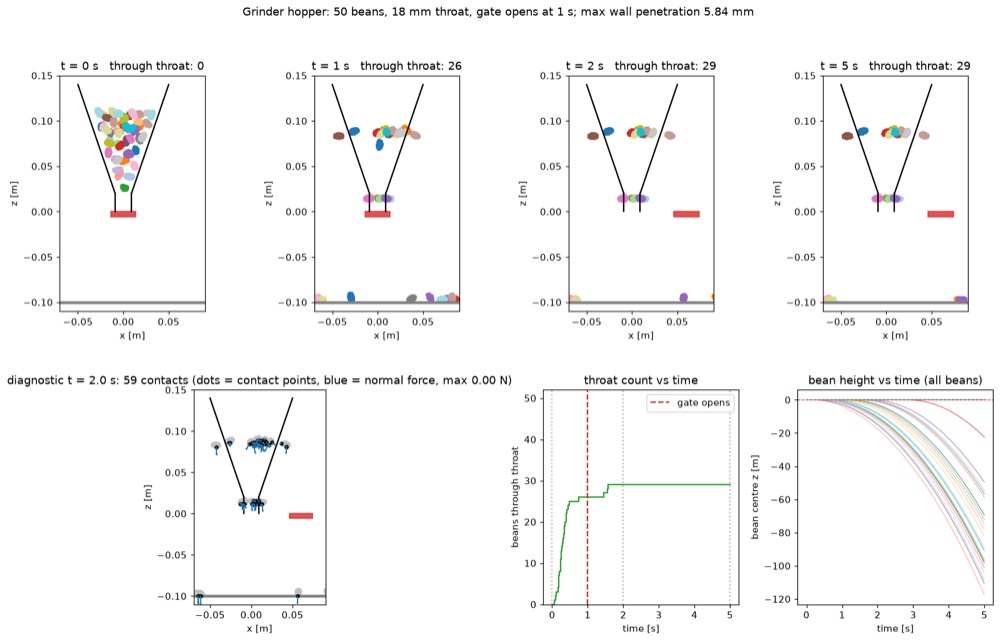
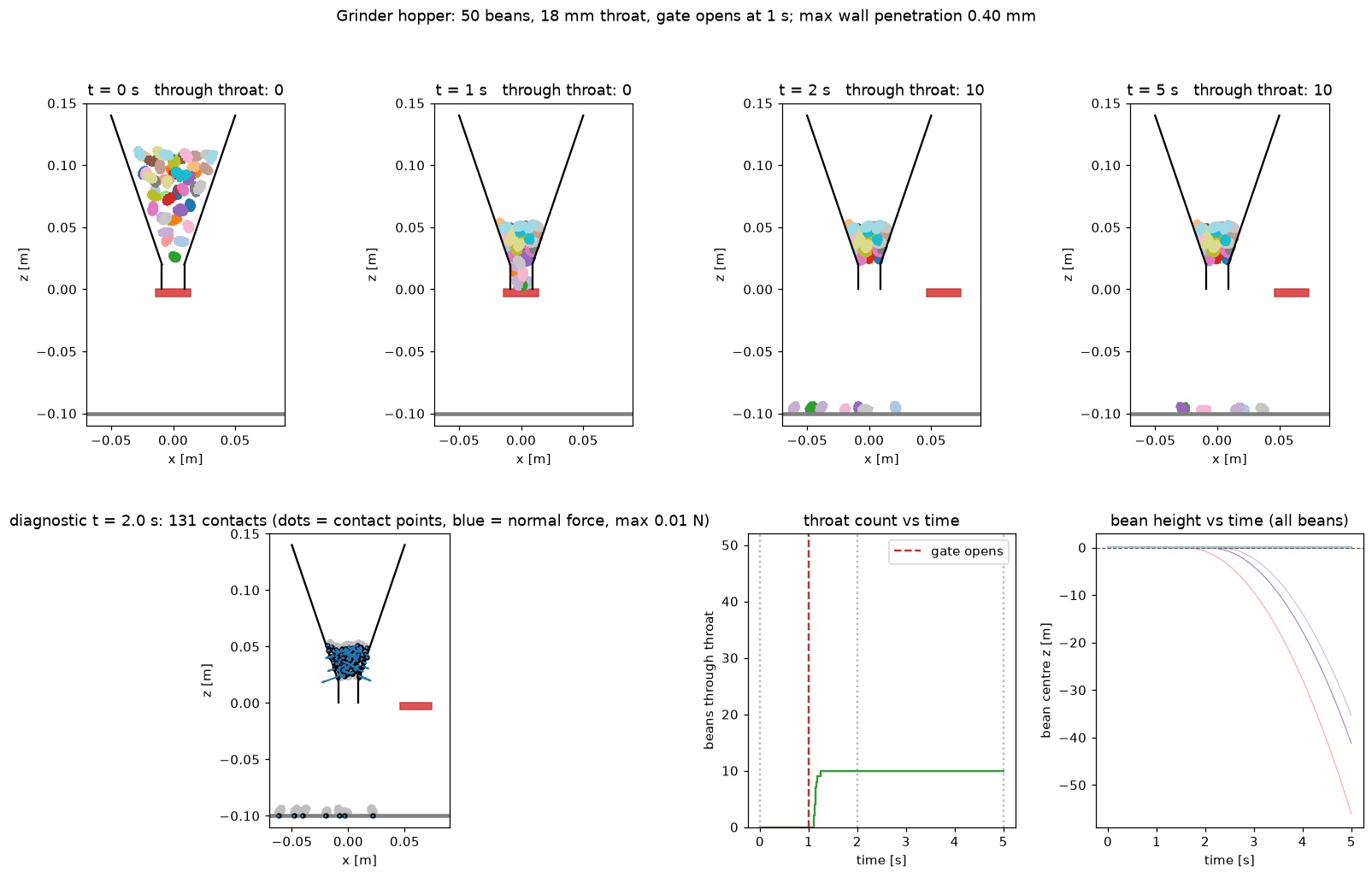
Only 10 of the 50 beans get out by 5 s, and beans 19, 20 and 24 fall through the tray and out of the model.
What the harness did to this run. The 12-minute clock ended it before the model finished, so this is where it had got to when time ran out.
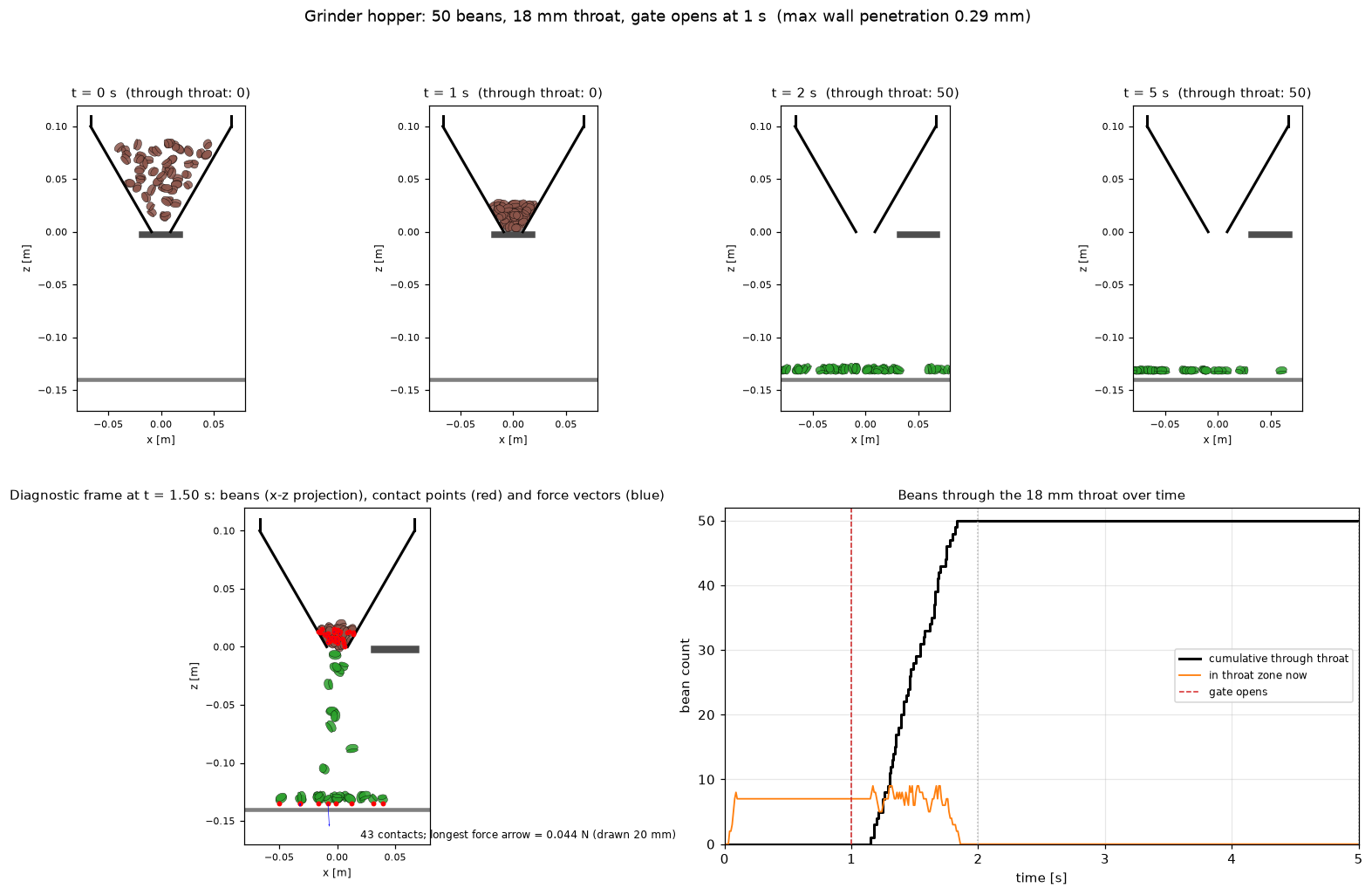 run 2 · 2r · $0.0306Its first beans jammed in the throat, so it made them smaller, and all 50 are out between 1 and 2 s.
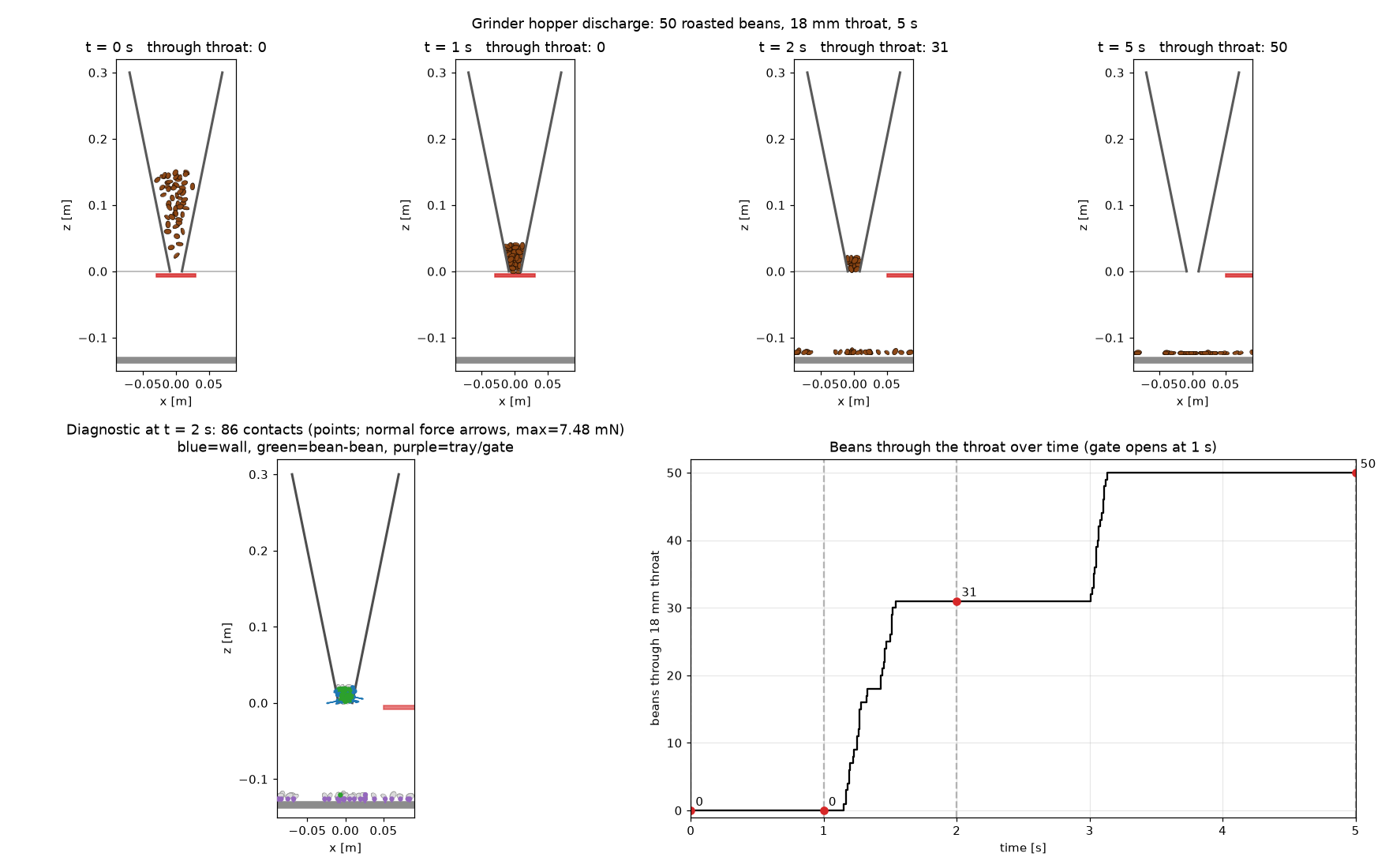 run 3 · 1r · $0.0176Held until 1 s, then 31 out by 2 s and all 50 by 5 s, after a jam in the throat clears.
Build a MuJoCo model of a grinder hopper releasing 50 roasted coffee beans through an 18 mm throat onto a tray, and simulate 5 s of it. Each bean is one free body made of two overlapping ellipsoids, giving it one flat face and one domed face. The hopper is a cone narrowing to the throat; a sliding gate under the throat opens at 1 s. Declare bean size, mass, friction and solver settings. Draw the hopper at 0, 1, 2 and 5 s, a diagnostic frame carrying contact points and force vectors, and beans through the throat over time. One figure, saved to the path in the OUT environment variable. Write the MJCF out to model.xml beside the script. Print the maximum penetration into the hopper walls, the count through the throat at each drawn time, and any bean that left the model.Frozen at v1. This model got this and nothing else.
The model.xml the script writes, loaded in MuJoCo and probed with rays against what a bean can actually hit. MuJoCo collides a mesh as its convex hull, so a cone made of one mesh is solid, and the probe counts it that way. The checker never runs the simulation, so whether the gate holds the beans and then lets them all out is judged by Claude Opus 5.5, GPT-6.1 Sol and Gemini 4 Argon, each shown the brief, the figure, the printed count and the rule, and never which model made it. On 2026-10-16 all three agreed on all ten results, and with the verdicts first published, for $0.52. The rule was written after Claude Opus 5.5 had looked at the runs. How it is scored, and this run's files on GitHub.