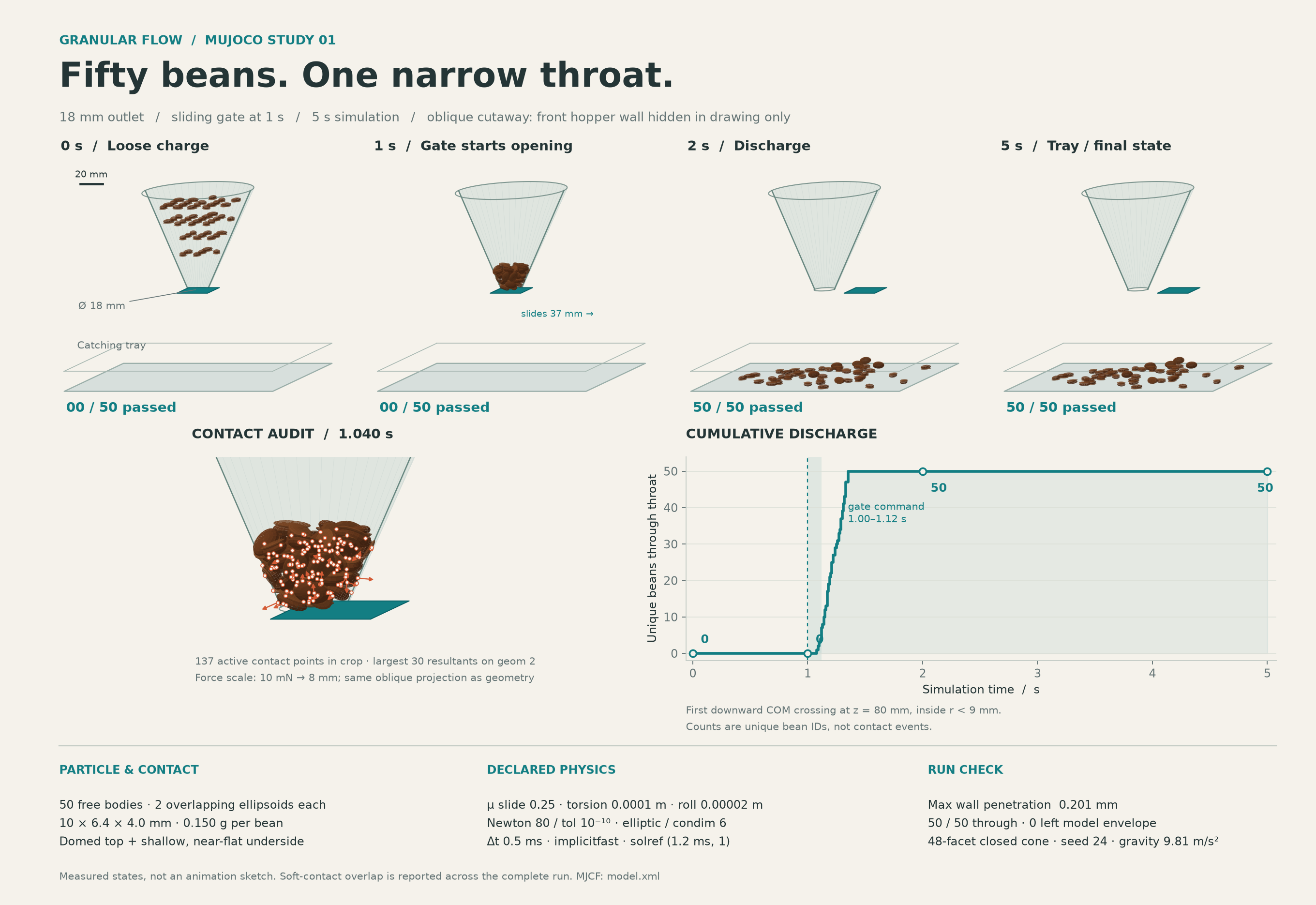
hopper.py · 231 lines
"""50-bean hopper: actual MuJoCo dynamics, Matplotlib projection of recorded states.
Run with OUT=/path/to/figure.png python hopper.py (mujoco, numpy, matplotlib).
SI units throughout. A shallow lower ellipsoid approximates, not literally makes,
a planar bean face. Cone walls are a closed 48-sided convex-mesh assembly.
"""
from pathlib import Path
import os
import numpy as np
import mujoco as mj
import matplotlib
matplotlib.use('Agg')
import matplotlib.pyplot as plt
from matplotlib.collections import PolyCollection
from matplotlib.patches import FancyArrowPatch

HERE = Path(__file__).resolve().parent
N, DT, T, ZTH = 50, 0.0005, 5.0, 0.080
rng = np.random.default_rng(24)
# Non-overlapping seeded lattice, deliberately loose at t=0; no hidden settling.
starts = []
for z in [0.113, 0.128, 0.143, 0.158]:
    candidates = [(x,y) for x in np.arange(-.036,.037,.013)
                  for y in np.arange(-.036,.037,.013)
                  if np.hypot(x,y) < .009+(z-.080)*(.039/.090)-.007]
    rng.shuffle(candidates)
    for x,y in candidates:
        starts.append((x,y,z))
starts = starts[:N]
assert len(starts) == N
asset, walls = [], []
# Each wedge has an inner planar face tangent to the specified cone.
ns = 48
for i in range(ns):
    a, b = 2*np.pi*np.array([i,i+1])/ns
    vertices=[]
    for z, r in [(.080,.009),(.170,.048)]:
        for rr in [r/np.cos(np.pi/ns),(r+.002)/np.cos(np.pi/ns)]:
            for th in [a,b]: vertices.append((rr*np.cos(th),rr*np.sin(th),z))
    asset.append(f'<mesh name="wallmesh{i}" vertex="'+ ' '.join(f'{v:.9f}' for p in vertices for v in p)+'"/>')
    walls.append(f'<geom name="wall{i}" type="mesh" mesh="wallmesh{i}" rgba="0.5 0.6 0.6 0.25"/>')
beans=[]
for i, (x,y,z) in enumerate(starts):
    # Random yaw only avoids initial overlaps; full 6-DoF motion thereafter.
    yaw=rng.uniform(-np.pi,np.pi)
    beans.append(f'''<body name="bean_{i:02d}" pos="{x} {y} {z}" quat="{np.cos(yaw/2)} 0 0 {np.sin(yaw/2)}">
      <freejoint/>
      <geom name="bean_{i:02d}_dome" type="ellipsoid" size=".0049 .0030 .0018" pos="0 0 .0009" mass=".00011" rgba=".28 .12 .055 1"/>
      <geom name="bean_{i:02d}_face" type="ellipsoid" size=".005 .0032 .0007" pos="0 0 -.0006" mass=".00004" rgba=".36 .18 .08 1"/>
    </body>''')
xml=f'''<mujoco model="Roasted coffee / 18 mm gated hopper">
 <compiler angle="radian" autolimits="true"/>
 <option timestep="{DT}" gravity="0 0 -9.81" integrator="implicitfast" solver="Newton" iterations="80" tolerance="1e-10" cone="elliptic" impratio="5"/>
 <size nconmax="8000" njmax="24000"/>
 <default><geom friction=".25 .0001 .00002" condim="6" solref=".0012 1" solimp=".95 .99 .0002" margin="0"/></default>
 <asset>{''.join(asset)}</asset>
 <worldbody>
  {''.join(walls)}
  <geom name="tray" type="box" pos="0 0 -.002" size=".095 .075 .002" rgba=".5 .6 .6 1"/>
  <geom name="tray_xp" type="box" pos=".096 0 .008" size=".001 .076 .010"/>
  <geom name="tray_xn" type="box" pos="-.096 0 .008" size=".001 .076 .010"/>
  <geom name="tray_yp" type="box" pos="0 .076 .008" size=".095 .001 .010"/>
  <geom name="tray_yn" type="box" pos="0 -.076 .008" size=".095 .001 .010"/>
  <body name="gate" pos="0 0 .0792" gravcomp="1">
   <joint name="gate_slide" type="slide" axis="1 0 0" range="0 .037" damping="1"/>
   <geom name="gate_plate" type="box" size=".014 .015 .0008" mass=".02" friction=".25 .0001 .00002" rgba=".1 .6 .6 1"/>
  </body>
  {''.join(beans)}
 </worldbody>
 <!-- Gate runs in an ideal guide; suppress gate/world contact at the flush seam. -->
 <contact><exclude body1="world" body2="gate"/></contact>
 <actuator><position name="open_gate" joint="gate_slide" kp="300" kv="4" ctrlrange="0 .037"/></actuator>
</mujoco>'''
(HERE/'model.xml').write_text(xml)
# The render harness copies this script into a scratch directory; also deliver
# the MJCF beside the submitted source when running in that harness.
if HERE != Path('/work') and Path('/work/hopper.py').exists():
    Path('/work/model.xml').write_text(xml)
model=mj.MjModel.from_xml_string(xml)
data=mj.MjData(model)
wallids={mj.mj_name2id(model,mj.mjtObj.mjOBJ_GEOM,f'wall{i}') for i in range(ns)}
bodyids=np.array([mj.mj_name2id(model,mj.mjtObj.mjOBJ_BODY,f'bean_{i:02d}') for i in range(N)])
geomids=np.array([[mj.mj_name2id(model,mj.mjtObj.mjOBJ_GEOM,f'bean_{i:02d}_{part}') for part in ['dome','face']] for i in range(N)]).ravel()
gateid=mj.mj_name2id(model,mj.mjtObj.mjOBJ_GEOM,'gate_plate')
frames={}; times=[]; counts=[]; passed=set(); escaped=set(); maxpen=0.; maxpentime=0.
mj.mj_forward(model,data)
previous=data.xipos[bodyids,2].copy()
def capture():
    contacts=[]
    for j in range(data.ncon):
        c=data.contact[j]; wrench=np.zeros(6)
        mj.mj_contactForce(model,data,j,wrench)
        if np.linalg.norm(wrench[:3])>1e-8:
            contacts.append((c.pos.copy(),c.frame.reshape(3,3).T @ wrench[:3]))
    return dict(pos=data.geom_xpos[geomids].copy(), rot=data.geom_xmat[geomids].reshape(-1,3,3).copy(),
                gate=data.geom_xpos[gateid].copy(), count=len(passed), contacts=contacts)
for step in range(round(T/DT)+1):
    t=step*DT
    if step:
        # 120 ms commanded withdrawal, starts exactly at 1 s.
        data.ctrl[0]=.037*np.clip((data.time-1.)/.120,0,1)
        mj.mj_step(model,data)
        # Synchronize derived positions/contacts to qpos at the reported time.
        mj.mj_forward(model,data)
    pos=data.xipos[bodyids]
    for i in np.where((previous>=ZTH)&(pos[:,2]<ZTH))[0]:
        if np.hypot(*pos[i,:2])<.009: passed.add(int(i))
    previous=pos[:,2].copy()
    for i in np.where((np.abs(pos[:,0])>.100)|(np.abs(pos[:,1])>.080)|(pos[:,2]<-.010)|(pos[:,2]>.200))[0]:
        escaped.add(int(i))
    for j in range(data.ncon):
        c=data.contact[j]
        if (c.geom1 in wallids or c.geom2 in wallids) and -c.dist>maxpen:
            maxpen=-c.dist; maxpentime=t
    if step%20==0: times.append(t); counts.append(len(passed))
    if step in [0,2000,4000,10000,2080]: frames[round(t,3)]=capture()
print(f'MuJoCo {mj.__version__}; {N} beans; timestep {DT:g} s; simulated {data.time:.3f} s')
print('Bean: 10 × 6.4 × 4.0 mm envelope; 0.150 g; overlapping dome + shallow-face ellipsoids.')
print('Friction (slide / torsion / roll): 0.25 / 0.0001 m / 0.00002 m; gate slide 0.25.')
print('Newton, 80 iterations, tolerance 1e-10; elliptic cone, condim 6; implicitfast; solref 0.0012 1.')
print(f'Maximum hopper-wall penetration: {maxpen*1000:.4f} mm at {maxpentime:.4f} s')
for t in [0.,1.,2.,5.]: print(f't={t:.0f} s: {frames[t]["count"]}/50 beans through throat')
print(f'Final gate withdrawal: {(data.geom_xpos[gateid,0])*1000:.2f} mm')
print('Beans that left the model envelope: '+(', '.join(f'bean_{i:02d}' for i in sorted(escaped)) if escaped else 'none'))

# All geometry below is projected from the simulated poses, not illustrative
# trajectories. xz oblique view: front shell is omitted only for visibility.
BG='#f5f2eb'; INK='#243536'; MUTED='#647475'; TEAL='#137e83'; ORANGE='#d45b35'
plt.rcParams.update({'font.family':'DejaVu Sans','font.size':10,'text.color':INK,'axes.labelcolor':INK,'xtick.color':MUTED,'ytick.color':MUTED,'axes.edgecolor':'#c5ccc6'})
fig=plt.figure(figsize=(16,11),facecolor=BG)
gs=fig.add_gridspec(2,4,left=.045,right=.97,bottom=.27,top=.815,hspace=.27,wspace=.13,height_ratios=[1.13,1])
P=np.array([[1,.36,0],[0,.17,1]])
view=np.cross(P[0],P[1]); view=view/np.linalg.norm(view)
def proj(v): return np.asarray(v)@P.T*1000
# Surface tessellation shared by all ellipsoids.
verts=[]
for a in np.linspace(0,np.pi,10):
    for b in np.linspace(0,2*np.pi,19)[:-1]: verts.append([np.sin(a)*np.cos(b),np.sin(a)*np.sin(b),np.cos(a)])
verts=np.array(verts)
faces=np.array([[r*18+j,r*18+(j+1)%18,(r+1)*18+(j+1)%18,(r+1)*18+j] for r in range(9) for j in range(18)])
light=np.array([-.4,-.6,1.]); light/=np.linalg.norm(light)
def bean_art(ax,s):
    polys=[]; colors=[]; depths=[]
    for k,(p,R) in enumerate(zip(s['pos'],s['rot'])):
        sizes=model.geom_size[geomids[k]]
        vv=(verts*sizes)@R.T+p
        normal=(verts[faces].mean(axis=1)/sizes)@R.T
        normal/=np.maximum(np.linalg.norm(normal,axis=1)[:,None],1e-10)
        visible=normal@view>0
        shade=.57+.43*np.clip(normal@light,0,1)
        base=np.array([.43,.235,.12]) if k%2==0 else np.array([.50,.29,.15])
        for f in np.where(visible)[0]:
            polys.append(proj(vv[faces[f]])); colors.append(np.clip(base*shade[f],0,1)); depths.append(vv[faces[f]].mean(axis=0)@view)
    order=np.argsort(depths)
    ax.add_collection(PolyCollection([polys[i] for i in order],facecolors=[colors[i] for i in order],edgecolors='none',zorder=4))
def path(ax,xyz,**kw):
    p=proj(xyz); ax.plot(p[:,0],p[:,1],**kw)
def apparatus(ax,s,zoom=False):
    # back shell, physical 48-facet cone; full mouth/throat rings as outlines.
    for i in range(24):
        a,b=2*np.pi*np.array([i,i+1])/48
        xyz=[[r*np.cos(th),r*np.sin(th),z] for r,z,th in [(.009,.080,a),(.048,.170,a),(.048,.170,b),(.009,.080,b)]]
        ax.add_collection(PolyCollection([proj(xyz)],facecolors='#dfe5df',edgecolors='#d2dcd7',linewidths=.25,zorder=0))
    theta=np.linspace(0,2*np.pi,120)
    for r,z in [(.009,.080),(.048,.170)]: path(ax,np.c_[r*np.cos(theta),r*np.sin(theta),np.full(len(theta),z)],color='#809791',lw=.9,zorder=2)
    for x in [-1,1]: path(ax,[[x*.009,0,.080],[x*.048,0,.170]],color='#688780',lw=1.1,zorder=2)
    tray=np.array([[-.095,-.075,0],[.095,-.075,0],[.095,.075,0],[-.095,.075,0]])
    ax.add_collection(PolyCollection([proj(tray)],facecolors='#d7dfdc',edgecolors='#9bafaa',lw=1,zorder=0))
    for a,b in zip(tray,np.roll(tray,-1,axis=0)):
        path(ax,[a+[0,0,.018],b+[0,0,.018]],color='#a8b8b2',lw=.7,zorder=1)
    g=s['gate']; plate=np.array([[-.014,-.015,0],[.014,-.015,0],[.014,.015,0],[-.014,.015,0]])+g
    ax.add_collection(PolyCollection([proj(plate)],facecolors=TEAL,edgecolors='#076065',linewidths=.8,zorder=3))
    bean_art(ax,s)
    ax.set_aspect('equal'); ax.set_facecolor(BG)
    ax.set_xlim((-34,57) if zoom else (-125,125)); ax.set_ylim((65,122) if zoom else (-19,191))
    ax.axis('off')

labels=['Loose charge','Gate starts opening','Discharge','Tray / final state']
for j,t in enumerate([0.,1.,2.,5.]):
    ax=fig.add_subplot(gs[0,j]); apparatus(ax,frames[t])
    ax.set_title(f'{t:.0f} s  /  {labels[j]}',loc='left',fontsize=12,fontweight='bold',pad=15)
    ax.text(.02,-.06,f'{frames[t]["count"]:02d} / 50 passed',transform=ax.transAxes,fontsize=12,color=TEAL,fontweight='bold')
    if j==0:
        ax.annotate('Ø 18 mm',xy=(0,80),xytext=(-109,62),fontsize=9,color=MUTED,arrowprops={'arrowstyle':'-','color':MUTED,'lw':.7})
        ax.text(-110,26,'Catching tray',fontsize=9,color=MUTED)
        ax.plot([-107,-87],[176,176],color=INK,lw=2); ax.text(-97,182,'20 mm',ha='center',fontsize=8)
    if j==1:
        ax.annotate('slides 37 mm →',xy=(10,77),xytext=(9,55),fontsize=8,color=TEAL)

ax=fig.add_subplot(gs[1,:2]); diag=frames[1.04]; apparatus(ax,diag,zoom=True)
ax.set_title('CONTACT AUDIT  /  1.040 s',loc='left',fontsize=12,fontweight='bold',pad=16)
cs=[(p,f) for p,f in diag['contacts'] if 65<proj(p)[1]<122 and -34<proj(p)[0]<57]
# A common, quantitative scale for all displayed arrows; no unit vectors.
strong=sorted(cs,key=lambda c:np.linalg.norm(c[1]),reverse=True)[:30]
fmax=max([np.linalg.norm(f) for p,f in strong]+[.001])
fref=10**np.ceil(np.log10(fmax/2))
scale=.008/fref
for p,f in strong:
    a=proj(p); b=proj(p+scale*f)
    ax.add_patch(FancyArrowPatch(a,b,arrowstyle='-|>',mutation_scale=7,lw=1,color=ORANGE,zorder=7))
if cs:
    pp=proj([p for p,f in cs]); ax.scatter(pp[:,0],pp[:,1],s=9,facecolor=BG,edgecolor=ORANGE,linewidth=.7,zorder=8)
ax.text(.01,-.10,f'{len(cs)} active contact points in crop · largest {len(strong)} resultants on geom 2\nForce scale: {fref*1000:g} mN → 8 mm; same oblique projection as geometry',transform=ax.transAxes,fontsize=9,color=MUTED,linespacing=1.6)

ax=fig.add_subplot(gs[1,2:]); ax.set_facecolor(BG)
ax.axvspan(1,1.12,color=TEAL,alpha=.09,lw=0)
ax.axvline(1,color=TEAL,lw=1,ls=(0,(3,3)))
ax.step(times,counts,where='post',color=TEAL,lw=2.4)
ax.fill_between(times,counts,step='post',color=TEAL,alpha=.07)
for t in [0.,1.,2.,5.]:
    c=frames[t]['count']; ax.plot(t,c,'o',mfc=BG,mec=TEAL,mew=1.5,ms=6,zorder=4)
    ax.annotate(str(c),(t,c),xytext=(-9 if t==5 else 7,9 if c<45 else -18),textcoords='offset points',fontsize=10,fontweight='bold',color=TEAL)
ax.text(1.35,36,'gate command\n1.00–1.12 s',color=TEAL,fontsize=9)
ax.set(xlim=(-.06,5.08),ylim=(-2,54),xticks=np.arange(6),yticks=np.arange(0,51,10),xlabel='Simulation time  /  s',ylabel='Unique beans through throat')
ax.set_title('CUMULATIVE DISCHARGE',loc='left',fontsize=12,fontweight='bold',pad=16)
ax.grid(axis='y',color='#dce0d8',lw=.7); ax.spines[['top','right']].set_visible(False)
ax.text(0,-.34,'First downward COM crossing at z = 80 mm, inside r < 9 mm.\nCounts are unique bean IDs, not contact events.',transform=ax.transAxes,color=MUTED,fontsize=9,linespacing=1.6)

fig.text(.045,.951,'GRANULAR FLOW  /  MUJOCO STUDY 01',color=TEAL,fontsize=11,fontweight='bold')
fig.text(.045,.904,'Fifty beans. One narrow throat.',fontsize=30,fontweight='bold')
fig.text(.045,.866,'18 mm outlet   /   sliding gate at 1 s   /   5 s simulation   /   oblique cutaway: front hopper wall hidden in drawing only',fontsize=11,color=MUTED)
fig.add_artist(plt.Line2D([.045,.97],[.176,.176],transform=fig.transFigure,color='#c4ccc5',lw=1))
fig.text(.045,.145,'PARTICLE & CONTACT',fontsize=10,fontweight='bold',color=TEAL)
fig.text(.045,.120,'50 free bodies · 2 overlapping ellipsoids each\n10 × 6.4 × 4.0 mm · 0.150 g per bean\nDomed top + shallow, near-flat underside',fontsize=10,linespacing=1.6,va='top')
fig.text(.37,.145,'DECLARED PHYSICS',fontsize=10,fontweight='bold',color=TEAL)
fig.text(.37,.120,'μ slide 0.25 · torsion 0.0001 m · roll 0.00002 m\nNewton 80 / tol 10⁻¹⁰ · elliptic / condim 6\nΔt 0.5 ms · implicitfast · solref (1.2 ms, 1)',fontsize=10,linespacing=1.6,va='top')
fig.text(.705,.145,'RUN CHECK',fontsize=10,fontweight='bold',color=TEAL)
fig.text(.705,.120,f'Max wall penetration  {maxpen*1000:.3f} mm\n{len(passed)} / 50 through · {len(escaped)} left model envelope\n48-facet closed cone · seed 24 · gravity 9.81 m/s²',fontsize=10,linespacing=1.6,va='top')
fig.text(.045,.028,'Measured states, not an animation sketch. Soft-contact overlap is reported across the complete run. MJCF: model.xml',fontsize=9,color=MUTED)
fig.savefig(os.environ['OUT'],dpi=170,facecolor=BG)
plt.close(fig)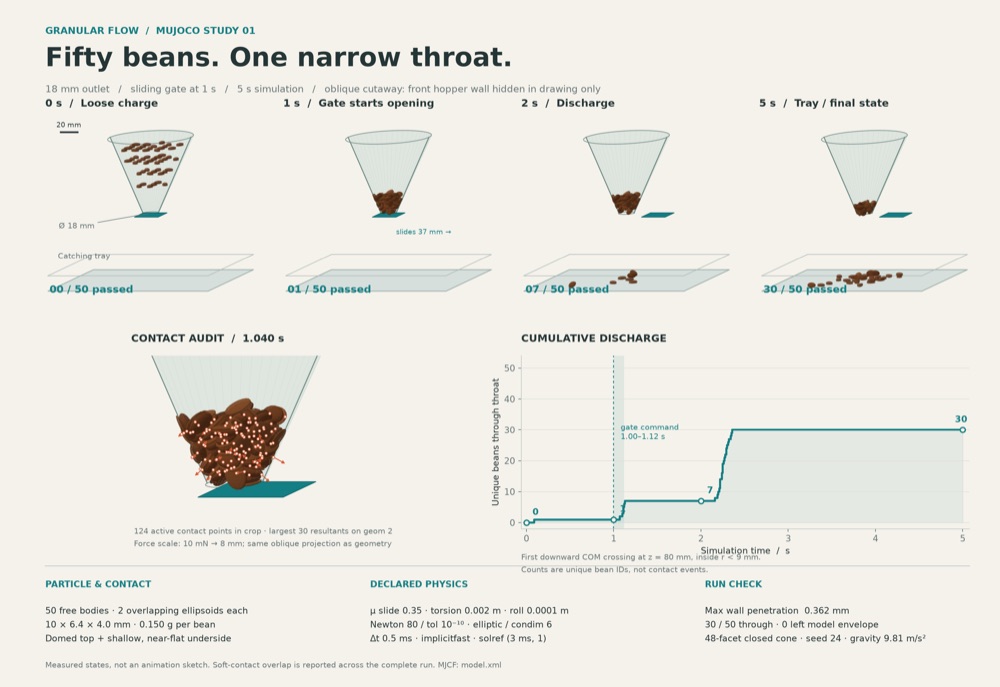
Held until 1 s and all 50 out by 2 s. The clock ended a fifth round mid-render, so round 4 is scored.
What the harness did to this run. The 12-minute clock ended it before the model finished, so this is where it had got to when time ran out.
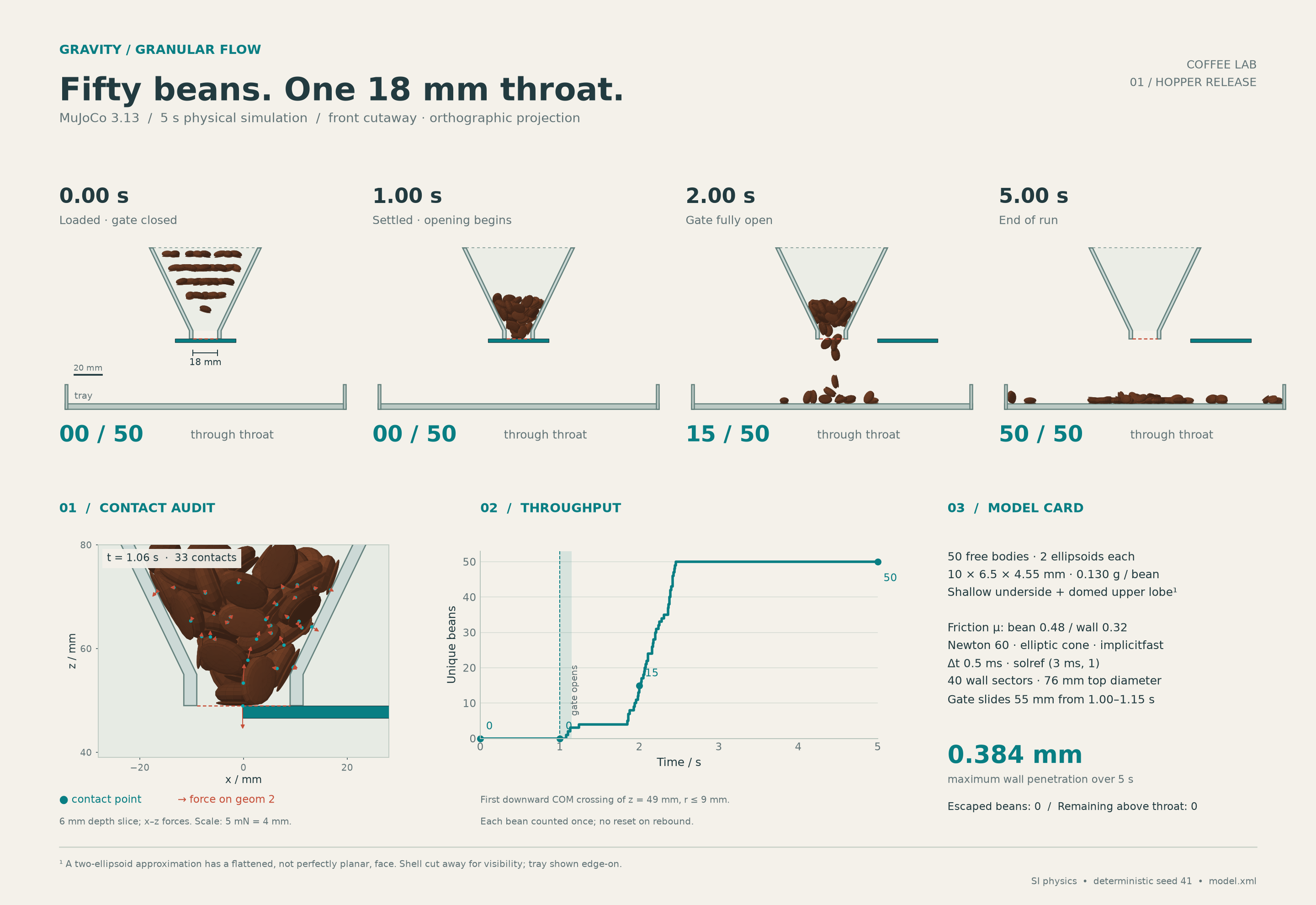
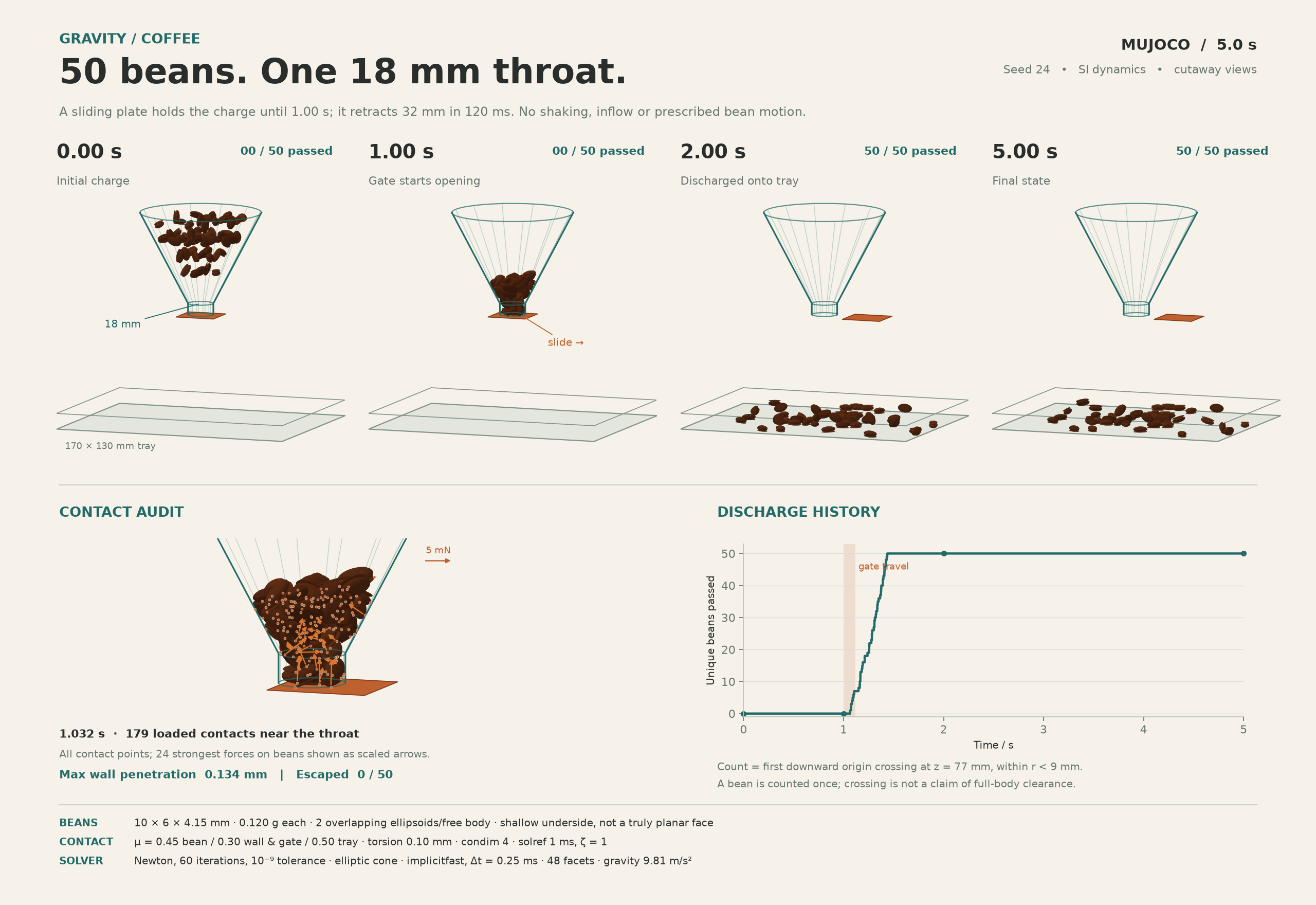
Build a MuJoCo model of a grinder hopper releasing 50 roasted coffee beans through an 18 mm throat onto a tray, and simulate 5 s of it. Each bean is one free body made of two overlapping ellipsoids, giving it one flat face and one domed face. The hopper is a cone narrowing to the throat; a sliding gate under the throat opens at 1 s. Declare bean size, mass, friction and solver settings. Draw the hopper at 0, 1, 2 and 5 s, a diagnostic frame carrying contact points and force vectors, and beans through the throat over time. One figure, saved to the path in the OUT environment variable. Write the MJCF out to model.xml beside the script. Print the maximum penetration into the hopper walls, the count through the throat at each drawn time, and any bean that left the model.Frozen at v1. This model got this and nothing else.
The model.xml the script writes, loaded in MuJoCo and probed with rays against what a bean can actually hit. MuJoCo collides a mesh as its convex hull, so a cone made of one mesh is solid, and the probe counts it that way. The checker never runs the simulation, so whether the gate holds the beans and then lets them all out is judged by Claude Opus 5.5, GPT-6.1 Sol and Gemini 4 Argon, each shown the brief, the figure, the printed count and the rule, and never which model made it. On 2026-10-16 all three agreed on all ten results, and with the verdicts first published, for $0.52. The rule was written after Claude Opus 5.5 had looked at the runs. How it is scored, and this run's files on GitHub.